

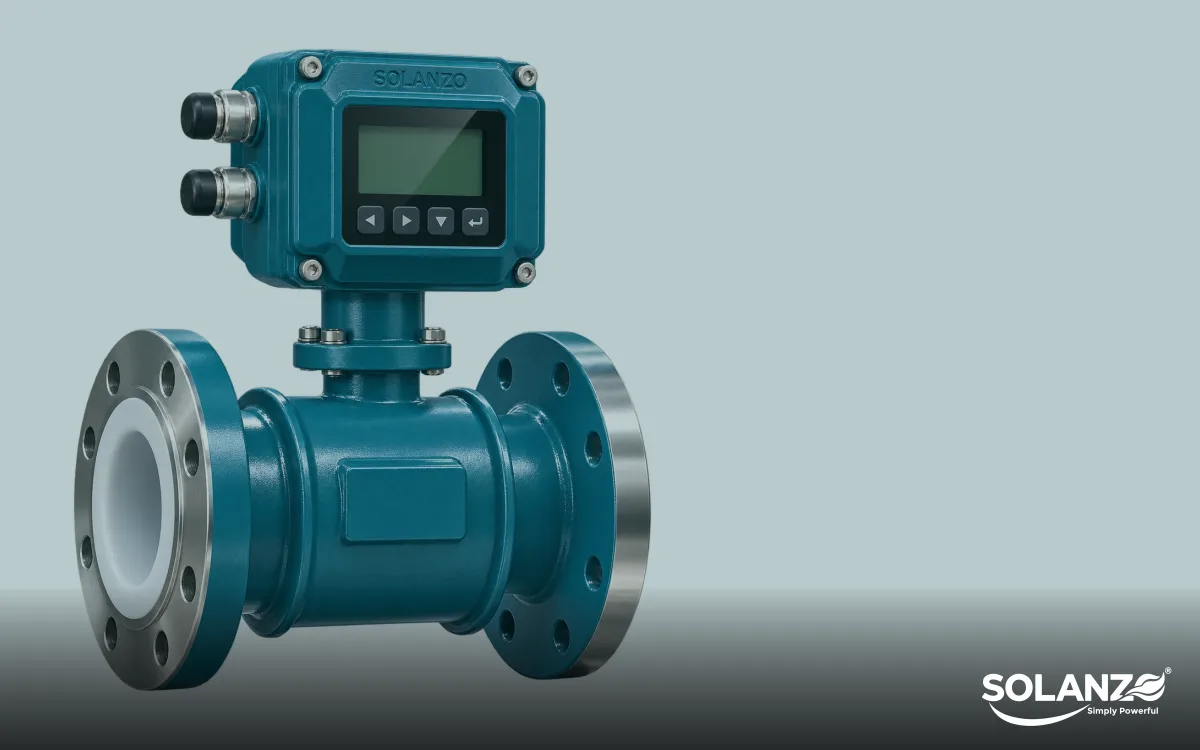
Water metering splits into two philosophies: measure the water mechanically, or measure it with physics. Mechanical meters have been the default for a century; electromagnetic meters have become the serious alternative for larger pipework and billing duty. Neither wins everywhere.
How each measures
A mechanical meter counts water by letting it move something: a piston, a turbine, a nutating disc. It is simple, needs no power, and its accuracy erodes as the mechanism wears. An electromagnetic meter applies Faraday's law: conductive water moving through a magnetic field generates a voltage proportional to flow. Nothing touches the water except the pipe liner; there is nothing to wear and nothing to clog.
Where the differences live
- Low flows. Electromagnetic meters stay accurate down to a trickle where mechanical meters stall, which is why they dominate district metering and non-revenue-water work.
- Degradation. A mechanical meter's error grows with wear; an electromagnetic meter's accuracy is stable for years. For billing, stability is the spec that matters.
- Blockage and pressure loss. A full-bore electromagnetic tube adds almost no head loss; every mechanical meter robs some pressure.
- Cost and power. Mechanical remains far cheaper at small sizes and needs no supply. Electromagnetic earns its premium from DN50 upward and wherever the meter is also an instrument.
Rule of thumb we apply: house connections and small services stay mechanical; bulk metering, billing-grade and network monitoring go electromagnetic. The boundary keeps shifting downward as the technology gets cheaper.